What a Pre-Marriage Verification Report Contains (and How to Read One)
Quick answer
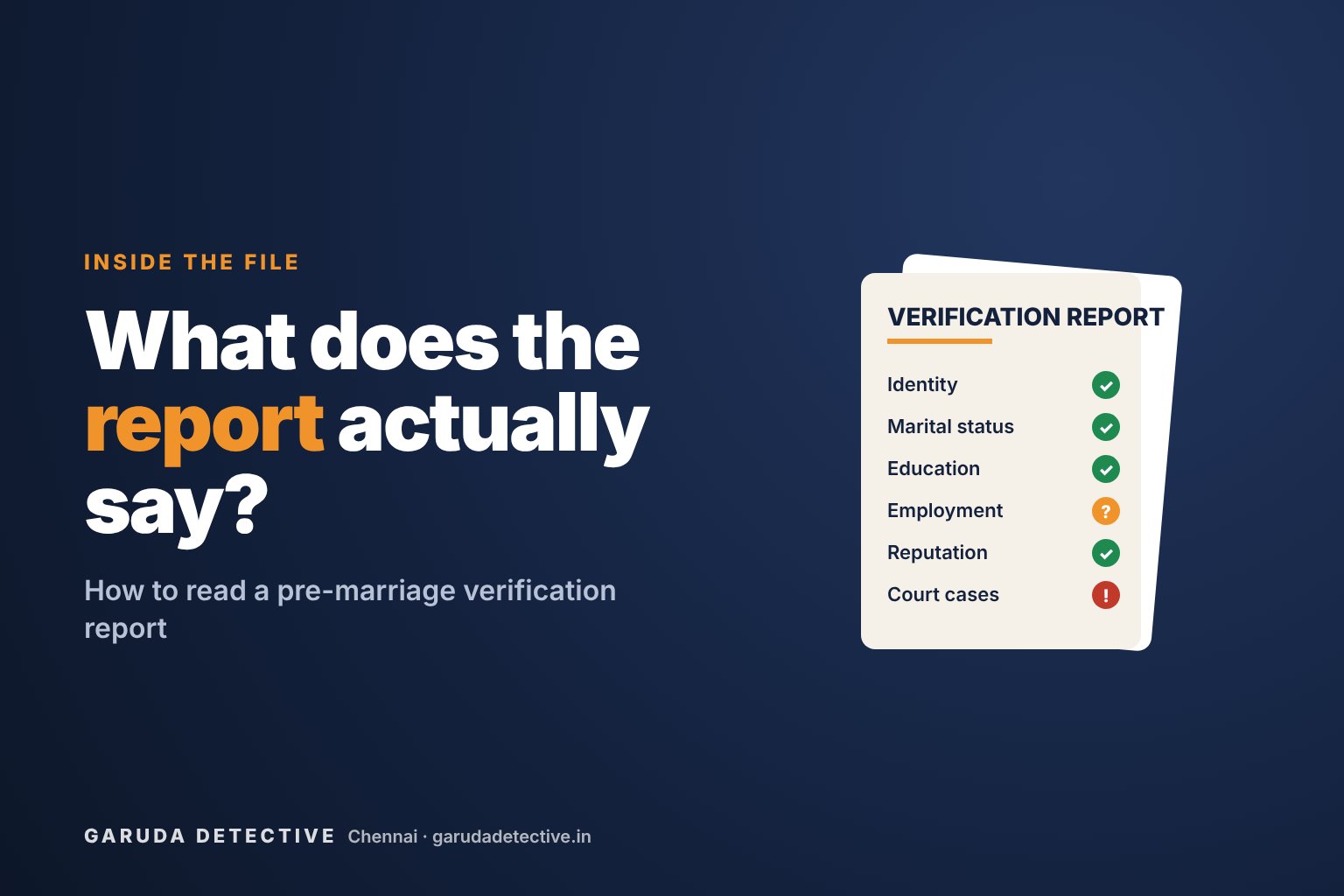
A pre-marriage verification report usually covers a summary of findings, identity, marital status, family and native place, education, job or business, visible finances, character and reputation, court cases, points that could not be confirmed, and notes on sources and method. Read each finding as verified, not confirmed or contradicted, and discuss anything unclear before deciding.
When a family asks for pre-matrimonial verification, what they finally receive is a written report. That report is what parents, and often the bride or groom too, will sit with before saying yes or no. Yet many families have never seen one before, and are not sure what it should include or how much weight to give each line. This guide explains what a good pre-marriage verification report usually contains and how to read it calmly.
If you are still deciding what to check, start with our pre-marriage verification checklist for Tamil families. This post picks up after that: the report itself.
What the report is for
A verification report has one job: to tell you, as clearly as possible, whether the facts presented in the proposal hold up. It compares what the bio-data, the family and the person have said with what could be confirmed through documents, public records and discreet enquiries. It is not a judgement on whether the match is right for your family. That decision stays with you.
A good report is factual, organised and honest about its limits. It should be easy for an elder in the family to read, not filled with jargon.
The sections a good report usually includes
Formats differ from agency to agency, but most thorough reports cover the following areas. The table shows what each section tells you.
| Section | What it tells you |
|---|---|
| Summary of findings | The main conclusions on one page: what matched, what did not, and what could not be confirmed. |
| Identity and personal details | Whether name, age, date of birth and address match the documents and the bio-data. |
| Marital status and history | Whether the person is unmarried, divorced or widowed as stated, and anything people remember about an earlier engagement or marriage. |
| Family background and native place | The family's standing, address, relatives and reputation in the native place. |
| Education | Whether the degrees and institutions claimed are consistent with what could be confirmed. |
| Employment or business | Whether the employer, designation or business exists and matches what was said. |
| Financial standing | What lawful sources show about property, business filings and visible lifestyle. |
| Character and reputation | What neighbours, colleagues and the local community say about behaviour and habits. |
| Court cases | Any civil or criminal case involving the person or close family that could be found in public court records. |
| Points not confirmed | What the agency tried to verify but could not, and why. |
| Sources and method notes | How each finding was reached, so you can judge how much to rely on it. |
Summary of findings
Read this first, but do not stop here. The summary should point you to the sections where something needs your attention.
Marital status and court cases
These are often the sections families care about most. In Tamil Nadu, marriages are required to be registered under the Tamil Nadu Registration of Marriages Act, 2009, but not every older marriage was registered, and marriages abroad may not appear in Indian records. Court cases are checked through public sources such as eCourts case status searches by party name. A good report will say clearly what was searched and what was found, rather than simply writing "nil".
Character and reputation
This section is built from neighbourhood and workplace enquiries. Treat it as a picture formed from several voices, not one person's opinion. A report should note when a comment came from only one source.
How to read each finding
Most findings fall into one of three groups. A clear report will label them, so you are never guessing.
- Verified: the claim was confirmed through a document, record or more than one reliable source.
- Not confirmed: the agency could not establish the fact either way. This is not the same as a problem; it simply means the point is still open.
- Contradicted: what was found does not match what was said. These are the points to discuss first.
Pay attention to the wording. "Neighbours were not aware of any earlier marriage" is different from "records show no earlier marriage", and both are different from "the person is unmarried". Each tells you how firm the finding is.
What to do with mixed findings
Most reports are mixed. For example, a family might find that the groom's education and family background are exactly as described, but his job title is more junior than the bio-data said. That is a real gap, but it may have an innocent explanation. Some steps that help:
- Ask the agency to explain any finding you do not fully understand, and how firm it is.
- Separate the serious points (marital status, court cases, major false claims) from smaller ones.
- Ask the other family about a gap politely and directly, and see whether the answer is consistent.
- If a point is not confirmed and matters to you, ask whether further lawful checks are possible.
- Take time. Do not let a fixed muhurtham date push you past an unanswered question.
Confidentiality of the report
A verification report contains personal information about another family. Keep it within the people who need to decide. Do not forward it widely or share it on family groups. Ask the agency how they store your report and the information you gave them, and who on their side can see it.
What a report will not contain
A lawful report is based on documents, public records, observation in public places and discreet enquiries. It never involves getting into someone's private accounts or devices, and it will not contain private bank statements or medical records obtained without consent. If anyone offers you that kind of material, treat it as a warning sign. Our post on whether hiring a private detective is legal in India explains the limits.
A report also cannot predict how a marriage will work out. It tells you whether the facts hold up, which is what you need to make an informed choice.
Questions to ask the agency before you hire
- Can I see a sample report format, with personal details removed?
- Which sections will my report include, and which will not apply to this case?
- Will each finding say how it was verified?
- How will you mark points that could not be confirmed?
- How long will the report take, and will it arrive before our decision date?
- Can I discuss the report with you after I receive it?
- How do you protect my information and the report?
For more on choosing well, read how to choose a detective agency in Chennai. If the proposal involves someone living abroad, our guide to NRI groom verification in the UK, US and Gulf covers the extra points to include. NRI cases are customised, and a consultation fee applies for calls from outside India.
How Garuda Detective can help
Garuda Detective Agency prepares clear, written pre-marriage verification reports for families across Tamil Nadu. Each finding is marked as verified, not confirmed or contradicted, with a note on how it was reached, and we walk you through the report so you understand every point. Our office is at 2/28, 2nd Floor, Mount Poonamallee Road, opposite DLF IT Park, Ramapuram, Chennai 600089. See our detective agency in Chennai page and pre-matrimonial verification in Chennai for how a full check works.
Our services start at ₹30,000. The final fee depends on the service you need and your requirements, and is fixed and shared after a free consultation call. See detective charges for what decides the fee. Call or WhatsApp +91 81242 37000, or contact us to talk through your proposal.
Frequently asked questions
What is checked in a pre-marriage investigation?
Usually identity, marital status and history, family background and native place, education, job or business, visible financial standing, character and reputation, and any court cases. The exact scope depends on the proposal and the family's specific doubts.
What does a pre-matrimonial investigation report look like?
A good report opens with a short summary, then has sections for each area checked. Each finding should be marked as verified, not confirmed or contradicted, with a note on the source or method, and a list of points that could not be confirmed.
Does "not confirmed" in a report mean something is wrong?
No. It means the agency could not establish the fact either way. If that point matters to your decision, ask the agency whether further lawful checks are possible, or ask the other family directly.
How long does it take to get a pre-marriage verification report?
It depends on the number of checks, the locations involved and how quickly information is available. Agree on a timeline before work begins, and make sure the report will reach you before your decision or engagement date.
How much does a pre-marriage verification cost?
Our services start at ₹30,000. The final fee depends on the service you need and your requirements, and is fixed and shared after a free consultation call.
Need a confidential brief?
Tell us the city, the person or company, and the fact you need confirmed. Garuda Detective will explain the scope before any field work starts.
Contact the agency